Thursday, March 31, 2016

Book Review: The American President - Part II Woodrow Wilson


Woodrow Wilson had the belief from early in his life that he was destined by God for greatness.  After securing the nomination in 1912 and hearing from a Democratic leader that the man thought he deserved some of the credit for Wilson's win, Wilson said, "Whether you did little or much, remember that God has ordained that I should be the next President of the United States. Neither you nor any other mortal or mortals could have prevented that."

What a scream he must have been at parties.

Author William Leuchtenburg considers Wilson's calling Congress into special session after his inauguration in 1913, "one of the more dramatic departures in the history of the presidency. To urge the necessity for tariff reform, he appeared before Congress in person - the first chief executive to do so since John Adams." While some traditionalists at the time complained about Wilson's 'stunt', Leuchtenburg said overall it made a positive impression on the nation and that it was, "an enduring contribution to the strength of the Executive Office." H.W. Brands writes, "This return to long-abandoned practice...was one of the hallmarks of the Wilson presidency, and one of his lasting contributions to American governance.." Wilson kept that Congress in session for eighteen straight months - something that had never happened before, not even during the Civil War.

Leuchtenburg considers Wilson's ability to secure his signature domestic outlook - the New Freedom - as a great example of presidential leadership. Leuchtenburg notes, "By dynamic leadership, Wilson had won enactment of the entire program of the New Freedom. He had given the country its first coherent banking system and had secured the first antitrust law since adoption of the original Sherman Act of 1890. In the difficult terrain of tariff reform - where [Grover] Cleveland had balked, where [Theodore] Roosevelt had feared to tread, where [William Howard] Taft had been all but impaled - Wilson had succeeded beyond every expectation....Above all, Wilson had demonstrated what many reasonable people had long doubted - that the Democratic Party could rule."

Yet, even with his domestic successes, the odds were long for Wilson's reelection in 1916 - the Democrats were the minority party. Wilson had only won in 1912 because of the Republican split between Taft and Roosevelt. Leuchtenburg notes, "The candidate of a reunified GOP in 1916 figured to be the likely victor. On Election Night, the New.York Times pronounced [Republican nominee Charles Evans] Hughes the winner, for he had swept almost all of the Northeast and the Midwest, running strongly even in former Democratic bastions....[thinking he was defeated], Wilson got set to carry out a plan he already had in place...he intended to resign at once and install [Hughes] in the White House, so that there would be no discontinuity in national leadership." For days, the election results were in doubt. As Leuchtenburg explains, "Finally, in California, a margin of less than 4,000 out of 1,000,000 ballots pushed Wilson over the top, making him the first Democrat since Andrew Jackson to win a second consecutive term in the White House." Despite this, it still took Hughes close to two weeks before he would concede the race.

Of course, Wilson's second term was dominated by World War I and the aftermath. While largely considered a failed term, Leuchtenburg points out that Wilson's, "success in ending [the war] as quickly and as deftly as he did stands as one of his greatest achievements." It was Wilson's demand for surrender from Germany rather than "peace negotiations" that ended the war when it did. As Leuchtenburg notes, "Wilson's firm stand, and his indication that he would look favorably on a [German] Republic, helped precipitate the abdication of the Kaiser on November 9, 1918."

Wilson's eventually futile effort to create a League of Nations with the United States as a charter member marred his second term.  Wilson's stubbornness in demanding that his entire plan be adopted, and his unwillingness to compromise, are widely considered his biggest failures. But Leuchtenburg also cites a political mistake often overlooked in the study of the League: Leuchtenburg says that Wilson made, "a grave mistake: he asked Americans to keep Democrats in power [in the 1918 mid-term elections] as evidence of their support of his conduct and prosecution of the war. His statement was an egregious misstep for a man who had spent a lifetime studying political behavior...that the party in power can almost always expect to lose votes in a mid-term election...Wilson's appeal for confidence probably neither lost nor won him votes [at the polls], but it had colossal consequences. He had all but invited Republicans to regard him as their enemy, and the miscarriage of his challenge meant that he would be bargaining with the great powers [in France] in a few weeks [at Versailles] having been, by his own reckoning, disowned. Furthermore, any treaty he did negotiate would have to get by the Senate Foreign Relations Committee, whose chairman, as a consequence of the elections, would shortly be his implacable foe, Henry Cabot Lodge."

On November 18, 1918, Wilson startled the country by announcing he would head up American delegation to Paris personally. No president had ever left the United States by crossing an ocean. Inexplicably, Wilson did not select one United States senator [the Senate would need to ratify any treaty] and only a token Republican to the American delegation. Leuchtenburg makes an interesting suggestion - Wilson could have chosen Taft as a delegate. Leuchtenburg concludes, however, that Wilson wouldn't do that because, "he wanted total control in Paris and refused to acknowledge that, to get the peace treaty ratified, he would need bipartisan support."

Subsequently, in March 1919, Lodge announced that Republicans already had the votes needed to block the treaty -  and this was even before it has been signed. Wilson was defiant. For Wilson, "It seemed inconceivable to him that the United States Senate, in order to avoid membership in the League, would go to the extreme of rejecting the peace treaty altogether."

Thinking he could bypass the Senate and go directly to the American people, on September 3, 1919, Wilson began his ill-fated three-week tour of the country to muster support for the Versailles Treaty. Leuchtenburg notes, "Again and again on his mission, he spelled out in a Manichaean mode what would ensue if the Treaty was not ratified." While his audiences were ecstatic in their support, Leuchtenburg says Wilson's words actually hardened the opposition in Washington. "Instead of attempting to coax senators to his side, he lashed out at them, and more than once descended to demagoguery."

Wilson's subsequent stroke and incapacitation have long been cited as one of the great traumas in the functioning of the American presidency. John Milton Cooper, Jr. wrote, "Wilson's stroke caused the worst crisis of presidential disability in American history. Out of a dynamic, resourceful leader emerged an emotionally unstable, delusional creature." And Leuchtenburg agrees, writing, "From October 1919 until the end of his term in March 1921, the United States did not have, in any meaningful sense, a president....Laws took effect without his signature because he could barely achieve a scrawl. Major events transpired - race riots that claimed more than a hundred lives; the Palmer raids launched by Wilson's attorney general, who ran roughshod over civil liberties during the Red Scare; the thorny reconversion from a war to a peace economy - with no input from the president, or, sometimes, even any recognition that they were happening." As an example, Leuchtenburg cites the Volstead Act [to enforce the 19th Amendment]. "Wilson's' veto of the Volstead Act enforcing Prohibition [which was quickly overridden] was actually prepared by Wilson aide Joe Tumulty and sent up to the Hill bearing the name of the president, who knew nothing about it."
,
Incredibly, Wilson considered a third term. Leuchtenburg notes, "Despite his affliction, Wilson actively sought re-nomination for a third term in 1920 and seriously expected that the Democrats would give it to him. He even made notes on the membership of the cabinet he planned to appoint in his forthcoming administration. He had no comprehension of how many Americans despised him or of what an albatross he had become to the party."

Wednesday, March 30, 2016

Book Review: The American President - Part I Roosevelt & Taft


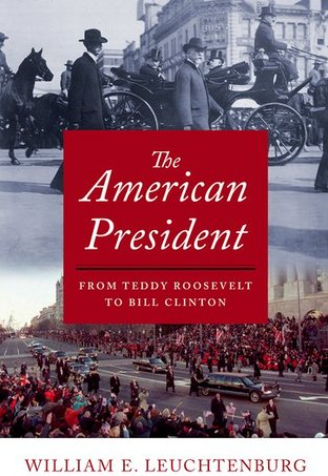
William Leuchtenburg is one of our national treasures. At age 93, he continues to contribute immensely to American historiography. His latest offering, The American President - From Theodore Roosevelt to Bill Clinton, is an epic tome of over 800 pages, chronicling each of the 20th-century presidents and the evolution of the American presidency under their individual tenures. As Leuchtenburg says at the outset, the book, "explores how the American presidency in the 20th-century became a very much more powerful institution than it had ever been before, and how that aggrandizement was brought about by the men that inhabited the White House."

Leuchtenburg's style, throughout the book, is to present the facts as they are believed to have occurred; provide the reader with samples of the historiography from both sides of interpretation of those facts; and to then provide his own belief. It is a style that wonderfully encapsulates Leuchtenburg’s 60+ year career in historical research, and provides the reader with multiple opinions from which to draw.

According to Leuchtenburg, for most of American history the presidency has been presented as a, "continuous tale, with each succeeding administration adding another chapter. By contrast, I perceive a great divide - with the 20th-century presidency markedly different from what preceded it." Initially in his earlier scholarship, Leuchtenburg had cited the presidency of Franklin Roosevelt as marking the beginning of this change. Since then, however, Leuchtenburg has reassessed his thinking. While initially considering that, "the creation of the Executive Office of the President in 1939 during FDR's second term [had] produced the big fault line....In the years since my first volume appeared I have come to conclude that the disjuncture came not in 1933, or 1939 but in 1901, when Theodore Roosevelt succeeded William McKinley."

In looking at those men, Leuchtenburg examines the good and the bad. Examples of the former included times when, "Teddy Roosevelt battled vested interests to preserve the nation's domain, when Woodrow Wilson sought to create a New World Order, when Franklin Delano Roosevelt acted for the welfare of the impoverished one-third of a nation, when Harry Truman promoted the Marshall plan for a beleaguered Europe, when Lyndon Johnson called upon Congress to grant long-overdue recognition of the civil rights of African-Americans, when Ronald Reagan spoke so movingly to the sorrow over the Challenger disaster..." Of course, Leuchtenburg notes, "the dark underside of presidential power cannot be ignored. Too often, presidents have lied to us. Too often, they have wasted the lives of our children in foreign ventures that should never have been undertaken. They are both the progenitors and the victims of inflated expectations, and when they overreach, they should be checked."

I’m dividing these reviews as Leuchtenburg does by chapter, and will be issuing these over the ensuing days:


THEODORE ROOSEVELT & WILLIAM HOWARD TAFT

The work opens with the assassination of William McKinley at the Pan-American Exposition in Buffalo in September 1901. Leuchtenburg notes that, in some ways, it was odd that McKinley was even a target, as the presidency was still considered a minor position at that point. For example, as late as 1901 the president, "had no control over the budgets of cabinet officials who ran the major departments. They answered not to him but to chummy congressional committee chairmen with whom they had colluded."

Still, there are some who argue that McKinley should be considered - not the last of the 'irrelevant' 19th-century presidents - but as the first of the strong executives of the 20th century.  They point to his success in the Spanish-American War as the first example of modern presidential authority. Leuchtenburg disagrees. "The reach of McKinley's tenure...fell considerably short of that of 20th-century presidents...Furthermore, he had only a tenuous grasp of foreign affairs, for he had never been abroad, and he was an active commander-in-chief largely because he had made such poor cabinet choices that he could rely upon neither his Secretary of the Navy nor his hopelessly incompetent Secretary of War"

Instead, Leuchtenburg argues, "McKinley made his greatest contribution to the growth of executive power inadvertently, when he took on Theodore Roosevelt as his running mate in 1900." In another of history's great ironies, McKinley's assassin, Leon Czolgosz, thought that by killing McKinley he was striking a blow against government.  Leuchtenburg writes, "Instead, his violent deed put in place of McKinley a far more dynamic leader - the rambunctious, ambitious, pugnacious Theodore Roosevelt - a succession that significantly altered the course of the American presidency."

Roosevelt made it clear from the very beginning that his ideas on the presidency differed greatly from any of his predecessors, and did so publicly in his first annual address to Congress in December 1901. Of that address, historian H.W. Brands has written, "Whatever readers made of the portents of Roosevelt's message, there was no mistaking the tone. This wasn't McKinley speaking; this was someone new, someone self-confidently assertive, and someone with a far grander sense of the public purpose than anyone who had ever held the presidency."

Roosevelt demonstrated this early in his tenure by intervening in the Anthracite Coal Strike.  Conservatives were shocked that a president would interject himself into a mediation between management and labor.  Leuchtenburg writes that by settling the coal strike, "He prepared the way for future presidents to assert a right to intercede when a domestic conflict endangered the national interest....By becoming the first chief executive to exert the power of the national government - not to crush a strike but to bring about a fair outcome - Roosevelt added a new dimension to the presidency." Leuchtenberg argues that Roosevelt saw the government, "as a mediating force among all elements in society."

Another major mark on the presidency cited by Leuchtenburg was the Roosevelt Corollary to the Monroe Doctrine.  Leuchtenburg notes that, "the president converted the Monroe Doctrine from a warning to European powers against intervention in the Western Hemisphere into an announcement that the United States reserved exclusively to itself the right to intervene....a dangerous precedent of U.S. patriarchy had been set."

Roosevelt's friend and hand-picked successor, William Howard Taft, had a different view of the office - although Leuchtenburg says it would be wrong to put him in the category of 19th-century presidents who sought to minimize the position.  Of Taft, historian Alan Brinkley has written, "He was a man of considerable intelligence, talent, and integrity. But he was temperamentally unsuited for the intensely political character of the presidency; and his uneasiness with the demands of the office seemed to evoke all his worst qualities - his tendency to procrastinate, his excessive legalism, even a kind of physical and intellectual laziness."

Yet, Leuchtenburg argues, Taft achieved many progressive goals: an eight-hour day for federal employees; a commission to explore workmen's compensation; and support for legislation to expand the authority of the Interstate Commerce Committee. Indeed, Leuchtenburg notes, "Taft launched twice as many antitrust suits in four years as 'trustbuster' Roosevelt had in nearly two terms."

Taft's view of the presidency was not strict constructionist but it also differed from that of his predecessor and his successor. While Taft acknowledged that a president could draw upon implied powers, and he found no fault with Abraham Lincoln's far-reaching actions during the Civil War, he also believed that, "our President has no initiative in respect to legislation given him by law except that of mere recommendation, and no legal...method of entering into the ...discussion of ....proposed legislation while pending in Congress.  The true view of the Executive function is...that the President can exercise no power which cannot be fairly and reasonably traced to some specific grant of power or justly implied...There is no underfunded residuum of power which he can exercise because it seems to him to be in the public interest."

As Leuchtenburg concludes in this chapter on Roosevelt and Taft, "Taft was fighting a losing battle, because his successor [Wilson] had come to take a decidedly Rooseveltian view of the powers of his office."

Wednesday, March 2, 2016

Book Review: Sinatra - The Chairman, By James Kaplan


The final installment in James Kaplan's two-part biography of Frank Sinatra, Sinatra: The Chairman, weighs in at 883-pages. Volume I, Frank: The Voice [2010] was a not-too-shabby 800-pages. Yet, of 1,683-pages, a mere 35-pages cover the years 1973-1998. While I'm not advocating that Kaplan should have done a three-part tome, perhaps a little less Mafia, fewer whores, and a few less Sinatra temper-tantrums might have allowed him to devote say, 100-pages to the last 25 years of Sinatra's incredible life. 

Clearly, by 1973, Sinatra was firmly established as a legend and - had he died that year - would have still gone down as one-of-if-not-the-greatest of all time.  Still, there is much, much more to mine out of Sinatra's last quarter-century than 35-pages. While Kaplan touches on some of those moments [the great comeback from 'retirement' in 1973; hitting the pop charts at age-64 with "Theme from New York, New York"; his marriage to Barbara Marx; and his declining health], there's more depth available there.  For one thing, the relationship between Frank and Barbara could be a volume in and of itself. The man who had been 'The Chairman' was - during much of his marriage to Barbara Blakely Marx - simply second-in-command.  By the end, he was her prisoner [if you believe Tina Sinatra's memoirs].

Still, having lodged that lengthy complaint, let me say that Sinatra: The Chairman is still every bit as valuable to Sinatriography as Kaplan's Frank: The Voice.  The second volume opens in the spring of 1954. By this time, Kaplan argues, Sinatra had grown up, "[in] his own particular way. His oaken baritone on the Capitol recordings, rich with sad knowledge - or, on up-tempo numbers, with swaggering authority - was a sea change from the tender Voice that had soothed America through the war." And Ava Gardner, "would be his muse for years after they broke up - specifically and crucially, the great Capitol years. 'Ava taught him to sing a torch song,' Nelson Riddle famously said. 'She taught him the hard way.'"

Among many troubling accounts in the book are the rumors of Sinatra's relationships with underage women. The first was in 1954 with the not-yet-16-year-old Natalie Wood. On this one, Kaplan isn't so sure. "God only knows what went on..." between them, he writes. "Wood appears to have been something more than a conquest where Frank was concerned.  He was a man on the cusp of middle age, almost certainly nostalgic for the days when he had made all those bobby-soxers swoon. Surely on some level, Natalie Wood reminded him of those girls and their idolatry."  Kaplan concludes, "A complex emotional bond formed between them, one that would continue as Frank and Natalie stayed friends, and now and then lovers, until she died at age forty-three in 1981. The second instance of such sordid activity occurred in 1968, when Sinatra dated a 15-year old stripper named Diane McCue. This one, Kaplan says, has multiple confirmations.

Not to suggest that Kaplan lingers just in the tawdry. Indeed, Kaplan carefully delves into the good and bad.  Kaplan writes, "With Frank Sinatra, the sublime and the ridiculous, the exquisite and the coarse, alternated so quickly and frequently that it's useless to try to reconcile them. He wasn't one thing or the other; he was both, and then a moment later he was something else again. The man who went to significant expense and effort to send a Sicilian-style message in granite to Dorothy Kilgallen [Sinatra sent her a real tombstone with her name on it after she wrote a negative column], the man who, when human relations called, periodically had his valet dial him up some professional company, was the same man who envisioned a new album that would combine Nelson Riddle's unparalleled arranging gifts and the rich and delicate sound of the classical string quartet [the Hollywood String Quartet] Frank had come to revere [resulting in the album Close to You]."

Perhaps the greatest gift of the two volumes - this second one in particular - is Kaplan's meticulous detail of all of Sinatra's recording sessions and the singles and albums that resulted, up to his 1971 'retirement'. A sampling: "No Sinatra album [before In The Wee Small Hours] had set an emotional ambience so strongly as this one would. The first two albums of his Capitol period, Songs for Young Lovers and Swing Easy! had each sustained a mood, but more simplistically: you could call them concept albums, if you wanted to cite concepts like 'romantic' or 'upbeat'. In the Wee Small Hours was a far more complex piece of work." Frank would later call it his "Ava [Gardner] album".

'The Rat Pack' was actually not originally the grouping we now think of [Sinatra, Dean Martin, Sammy Davis, Jr., Peter Lawford and Joey Bishop].  The first Rat Pack was born in the mid-1950s, and began in the living room of Humphrey Bogart and Lauren Bacall. Sinatra idolized Bogart. When Sinatra had been down on his luck, Bogie and Bacall took him in and made him a part of their circle. One night, with a group that included Bogart, Sinatra, Judy Garland, David Niven, Spencer Tracy and others, Bacall famously said, "I see the rat pack is all here." Bogart loved it and proposed they form a club, the Rat Pack. Bacall, in her memoir, recalled, "In order to qualify [for membership], one had to be addicted to nonconformity, staying up late, drinking, laughing, and not caring what anyone thought or said about us." On December 15, 1955, the New York Herald Tribune reported on the formation of the Holmby Hills [the Bogarts' neighborhood] Rat Pack, and that officers had been elected: Frank was Pack Master; Garland first vice-president; Bacall was Den Mother; and Bogart Rat-in-Charge of Public Relations, etc.

Shortly thereafter, Sinatra began a habit that he'd repeat over the next decade-and-a-half: bedding the widows of his friends. In perhaps the most famous case, Sinatra began a relationship with Bacall shortly after Humphrey Bogart died in 1957. He would do similar 'duty' with the widows of dead friends more than a few times over the next 15 or so years. The relationship with Bacall was serious enough that - after his divorce from Ava Gardner became official in mid-1957 - Sinatra and Bacall were engaged. He wanted to keep it secret, however; when she confirmed it to a reporter, he broke off the engagement and didn't speak to her again for years.

No Sinatra book would be complete without an analysis of his relationship with the Mafia [addressed in Volume I as well].  But, Kaplan cautions, "The myth has arisen that Frank Sinatra's unfortunate reverence for the Mafia...meant that he was all but a made man. In fact, while his mother's North Jersey connections had helped get him a couple of singing jobs early in his career, and a few of his wiseguy friends steered some work his way during his down period [but only some; not enough to turn his fortunes around],  Sinatra's Mob associations had far more to do with mutual admiration than affiliation. The gangsters liked his singing, his flash, and [at times] his unrepentant unruliness; he liked their power, their toughness, their swaggering style.  Growing up in an era when power was largely in the hands of white Protestant men, a time when Italian-Americans were just a half-step up the social ladder from African-Americans - and, like black people, were seen as simple, happy, and musical - Frank viewed the Mafia as a kind of unelected elect, an alternate aristocracy. He idolized them all his life, much as a small boy might idolize cowboys or soldiers."

The second Rat Pack - the one we know- actually preferred to be called The Clan [despite the racist proximity to 'The Klan'].  The first Clan was Sinatra, Dean Martin and Shirley MacLaine from the set of their movie, Some Came Running [the first of nine Sinatra/Martin movies] in summer/fall 1958. Then, in October 1958, Dean and Frank spontaneously walked from the audience up to join Judy Garland on-stage in an unrehearsed act during her performance at The Sands. Kaplan writes, "The evening had all the hallmarks of the Rat Pack era to come: genial sadism and coerciveness, combined with boozily uncertain entertainment value that shimmered away the morning after, leaving only the dull ache of a you-had-to-be-there hangover. And Sinatra was always in charge." Indeed, Kaplan, writes, "this second Rat Pack was a cult that grew around a man [Sinatra] who welcomed worship and demanded fealty."

According to Kaplan, the idea of the Rat Pack, "was born at a hinge of time in the American consciousness, a moment between the conformism of the 1950s and the chaos of the 1960s, an eye blink when the horrors and heroism of World War II were still in recent memory (and nuclear fear underlay every diversion), when compensatory excess, in the form of sex, alcohol, and cigarettes, was winked at and 20th century ideals of manhood had not yet been subverted by the androgynous aesthetic of rock 'n' roll."

Yet it was an act. Sinatra and Martin were not a team off-stage. Kaplan writes that, while there was mutual affection, "Sinatra and Martin...weren't teaming up on the golf course or in after-hours hijinks - but the act took an instant and powerful hold on America, or at least that part of America that paid attention to star behavior, which was much of America." The relationship between Sinatra and Sammy Davis was more intricate. Frank loved Sammy and vice-versa, but Kaplan points out that there was a clear pecking order - "Frank was the sun and Sammy the moon. Frank was the leader, Sammy the acolyte. This had partly to do with Frank's age and unexampled status in show business and partly to do with his domineering personality, but it was a function of Davis's personality as well."

So, Kaplan concludes, "The Rat Pack was an idea, even more than it was a reality. And though Frank, Dean, and Sammy were three real men, their respective myths tend, to this day, to jostle reality aside. Throw in Joey Bishop and Peter Lawford as window dressing, or ballast, and you've got a sharkskin-suited, skinny-tied, chain-smoking, chain-drinking, Dionysian parade float."

The unbelievable chapters detailing the John Kennedy-Sam Giancana-Judith Campbell Exner-Bobby Kennedy-Marilyn Monroe saga are extremely troubling. They could also fill up a week's worth of blog entries.  In a nutshell: Joseph Kennedy asked Sinatra to have Giancana pour enough money into the JFK campaign to secure the election for him; Sinatra complied and Giancana and his organization came through; Joe Kennedy's stroke in late-1961, however, put Bobby Kennedy in a powerful position within the Kennedy, family and Bobby hated Frank Sinatra; Sinatra eventually fell out of favor with both the Kennedys and Giancana - the latter very nearly contemplated taking out a contract on Sinatra's life. But Sinatra's voice saved his life, Kaplan writes, "And Frank knew it. And so he could continue to rub shoulders with Giancana and other hoodlums, doing small favors for them when it was convenient and doing nothing for them if he preferred. Sinatra's relationship with the Mob was a transaction, conducted in the counterfeit currency of the underworld: the gangsters got to bask in his aura, and he in theirs; each side pretended to do things for the other, and neither did much." As for the rest of the tale, well, a lot of people had sex - and I haven't even touched Marilyn Monroe [which might make me the only one who didn't].  Camelot indeed.

Perhaps the most disturbing story in either volume comes from a tale in mid-summer 1962. It involved a cocktail waitress at Cal-Neva that Sinatra used to date, Toni. She had gone on to marry a deputy sheriff, Richard Anderson, after her relationship with Sinatra ended. Even though she was now married, Sinatra still would make moves on her. Anderson finally told Sinatra to stay away from his wife. One night shortly thereafter, Anderson was waiting to pick up his wife and was standing in the kitchen when Sinatra came in, leading to a fight where Anderson hit Sinatra so hard that the performer could not go on for the next couple of days. Kaplan writes, "In retaliation, Sinatra had Anderson suspended from the police force. Two weeks later, the deputy sheriff and his wife were driving to dinner when a car moving at a high speed in the oncoming lane forced them off the road. The Anderson's car smashed into a tree, and Richard Anderson was killed instantly. His wife, thrown from the car, suffered multiple fractures. The other car - a maroon convertible with California plates, according to an eyewitness - never stopped, and the driver couldn't be traced." Sinatra was never officially implicated in the accident.

Kaplan does a fabulous job in analyzing Sinatra's relationships with many of his arrangers - Nelson Riddle, Gordon Jenkins, Billy May, etc.  But Kaplan argues that Sinatra was tighter with Quincy Jones than with any of the others. "Tightness with Sinatra almost invariably came about at his initiative, on his terms, and as a result of his needs. In this case, the intimacy indisputably had to do not on only with Jones' formidable skills and genuine personality but with the color of his skin. Ever since Sinatra was an unknown singer prowling the jazz clubs of 52nd Street, he had been crazy about the style and the genius of the great black musicians he'd seen and heard there....Now he [Sinatra] was in the same league as his [black] idols, but some part of Sinatra would always remain both an aspirant to blackness and an outsider.....Because of Sinatra's fascination with black culture and jazz, and because of Quincy Jones' gift for agreeableness without sycophancy, the arranger was able to work with Frank on a nearly even footing and to be a friend as well: an unprecedented situation, and one never to be duplicated."

Kaplan argues that Sinatra saw the rise of rock-and-roll with hatred and disgust: first because it effected his album sales and then because it effected his ability to relate to a larger and larger segment of the public, record-buying or otherwise. It explains, Kaplan argues, his relationship and marriage to Mia Farrow, as well as a change in his wardrobe from tuxedoes with monogramed cuff links to Nehru suits with beads, among other accommodations to the changing times.

The desire to once again reach the top of the charts led to one of Sinatra's most famous songs, "Strangers in Night" - a tune he absolutely hated but recognized immediately as a potential number-one hit. And Sinatra hadn't been to those heights on the charts in 20 years [with "Five Minutes More"] when he cut "Strangers" in 1966. Sinatra had always been someone who was more successful with albums rather than singles. But he hadn't even had a top-10 single since 1956 [with "Hey Jealous Lover!; another song he hated]. Yes, in 1966, Sinatra wanted a hit single. And "Strangers" did it. In July 1966, it overthrew The Beatles' "Paperback Writer" and Frank had his number one single.

But another problem with rock-and-roll for Sinatra was that the songwriters he had come to rely on were no longer producing as they once had. This led to Sinatra [and others in his genre] turning to popular music for tunes to record.  In some cases, the results were wonderful because it was Sinatra.  But, in others, not even a Sinatra or an Ella could save the end result.

One example of greatness, though, was Paul Anka's "My Way", written specifically by the songwriter for Sinatra.  Yet, for all the success Frank enjoyed with it, Sinatra was always ambivalent about the song,  Sinatra once said, "really ["My Way"] had nothing to do with my life whatsoever, I know it's a very big hit - and I love having big hits - but every time I get up to sing that song I grit my teeth; because no matter what the image may seem to be, I hate boastfulness in others. I hate immodesty, and that's how I feel every time I sing that song."  Even so, amazingly, Sinatra recorded it in just one take.

By early 1971, Frank was tired. And in pain; his right hand was the subject of numerous surgeries to try to correct a condition that made it very difficult to grasp a microphone.  So, on March 23, 1971, Frank Sinatra announced his retirement. It did not last. Two years later Frank announced he was coming back.  This led to one of the great examples of Frank's ability to make [or remake] his image. The title of his comeback album in 1973 was Ol' Blue Eyes is Back. Yet, Kaplan writes, nowhere in the mounds of his research of newspapers before 1973 can he find Frank Sinatra ever referred to as "ol' blue eyes." It didn't matter - overnight Frank Sinatra was ol' blue eyes, because he said he was. 

Sinatra's marriage to Barbara Marx on July 11, 1976, is clear demarcation in Sinatra's life. His daughter Tina - and, to some extent his daughter Nancy and son Frank Jr. agree - argues that it was Barbara Sinatra that had her husband performing concerts around the world long past the time he should have been in order to generate money to keep her in the style to which she'd become accustomed. As such, Sinatra did more than 1,000 concerts between 1976 and 1990. Even then, though, he was not done. He did 65 concerts in 1990; 73 in 1991; 84 in 1992, and 48 in 1994.  His last concert was February 25, 1995.

As to the quality of Sinatra's work over those final two decades, Kaplan writes, "...by the early 1980s the great voice began to alter and deteriorate. The cave-of-winds depths were still there, but the phenomenal breath control, the nearly freakish ability to sustain long notes, was not. The intonation, so glorious for so much of his career, now wavered. What he retained, what would stay with him almost until the very end, was his unparalleled feeling for lyrics, his way around a song's story...his sense of a song's essence was absolute."

In conclusion, the two-volume biography is very good, but not always pleasant reading. By page 1,683, however, you'll have a great appreciation for the life of Francis Albert Sinatra, whether you call him The Voice, The Chairman, or Ol' Blue Eyes.
Tuesday, February 23, 2016

The Return of the Hitler Font


So, The Wife has piles and piles of books throughout the house. I'll often catch a title here and there but to-date we've never read the same book - a 25-year tradition that Carly Simon's memoir, Boys in the Trees, might end. But that's for another day.  A few days ago I was passing The Wife's nightstand when I caught a glance at a book.  I walked a few paces and stopped: "Hmmmm. I've seen that book before." I walked backward three steps to take a second gander at the book, A Wild Swan.  I'd never heard of it, nor of the author, someone called Michael Cunningham. So, where in the hell had I seen this book before?

Most of the rest of that day it was driving me nuts. Then I thought more about it - maybe it was the cover; is it a similar cover to something? Pretty plain looking cover as you can see in the above right.  WAIT! The font! Holy hell: that's Hitler Font! As in Mein Kampf font. No, thought I: no publisher in his or her right mind would breathe life into a font that died over 70 years ago.  Along with the Hitler Mustache, the Hitler Comb-Over and the Hitler Salute, the Hitler Font died with Germany's defeat in World War II in 1945. Yet, here it is again.

Now, this is in no way to even remotely suggest that Mr. Cunningham is a Nazi. I don't know the man and for all I know he had zero input into the cover design. Nonetheless, it's a pretty ballsy thing to publish a book cover in the same font as the cover of Mein Kampf. I mean, even Howard Stern decided not to call his first book Mein Kampf  [he instead chose the more subtle Private Parts]. Even Howard realized that vestiges of Hitler's "brand" - while perhaps funny in the way that one uses laughter to comprehend and dismiss a horrible situation or person - was not ready for rehabilitation. I mean, it took Genghis Khan a good 600 years before he had his first knock-knock joke, in 1827: ["Knock-knock"; "Who's there?" "Khan". "Khan who?" "Genghis Khan, you idiot."....I didn't say it was  a funny joke].

I'd say that you won't see another Hitler Mustache in your lifetime. Perhaps some time around 2545 or so, some rebellious young Disney star [presumably male, but who knows] will sport it. There will be much uproar. Then an athlete will wear it. The next thing you know, Gillette will be selling razors designed specifically for trimming the Hitler Mustache. Now, the Hitler Come-Over has made a slight comeback. Without the aforementioned mustache, however, it can be hard to spot. Indeed, it may be that the two are inseparable and that the Hitler Comb-Over really is back but no one's noticed. Maybe that's what gave the publishers of A Wild Swan the idea to see if they could sneak in a return of the font.

The Hitler Salute, I'm afraid, has already made a comeback. You see it at sporting events - they don't call it the Hitler Salute, over course; but there's almost no difference between the Tomahawk Chop and Sieg Heil. That's not including the reappearance of the salute at various Republican presidential events this winter.

But the font? Who the hell saw that coming? You may argue that I'm being hyper-sensitive [that's been known to happen] and that the two fonts are different.  Yet, having seen various different covers of Mein Kampf in my life, it took me less than three seconds of looking at A Wild Swan to subconsciously make the connection. Now, it's just a matter of time before Microsoft adds "Hitler" to its drop-down menu of font-types in Word. Then you'll see a sports team redesign its brand and - holy hell - there's the Hitler Font on the Pittsburgh Steelers new typeface! A stadium full of Terrible Towels - printed, naturally, in Hitler Font, - waving in violent, furious passion, shown on a Jumbo-Tron with "This is Steeler Country" in Hitler Font written on the marquee, and all of a sudden we've got a real problem.

Especially if I'm wrong and the Hitler Mustache makes a quicker comeback than I expect, and half the players are wearing it. Well, at least their helmets will cover up any Comb-Overs

Thursday, February 18, 2016

100% Helpful Texts for Planning


There's a very unfriendly service provided by Verizon [and, for all I know, every other data carrier] that sends you friendly texts as you are drawing near the end of your data plan. Getting these texts is a bit jarring - particularly if it's two weeks until your 'cycle' ends. Of course, there's a helpful link you can use to buy a larger data plan.  Data being like heroin, however, it's a dangerous and shameless thing for Verizon to offer.  Then again, charging you for data is obscene in the first place, so there you go.

Looking at this message recently, I realized: how amazing would it be if other things in life worked this way? For example: what if you could receive a text that would say, "You've lived 90% of your life span. You might want to start making arrangements."?  Think of the possibilities. Think of the angst you could avoid.

So, say today I got a text [presumably this would also be from a data carrier] that said, "You have used 75% of your life span. Relax - but don't get too comfy." At my age, that would mean I'd have about another 16 years left to live from today. So, if I got a chest pain, I could easily write it off as indigestion and perhaps save an ER trip. Indeed, had I received such a message back on Thanksgiving, everyone could've been far more calm as I lay in a heap on the floor - knowing with firm conviction [because data carriers never make errors] that I still have 16 years to live.

Granted, these texts would be even more jarring than the data-limit ones. Particularly that 90% one. If I got that one today, it'd mean I have only five years left. Presumably, that would come with links to things like living wills, cemetery plots and life insurance carriers.

Of course, let's not just be morbid [for once] and consider other applications. Toward the end of an evening with your spouse/partner/fuck-buddy you could get a text saying, "The person you are with has used up 90% of their energy this evening. You better get started with the foreplay."  In employment situations, too, it'd be useful: "You have spent 75% of your allotted tenure with your employer. Time to brush up the resume." Or sitting through a long, God-awful movie/conversation/lecture/concert/religious ceremony, you could get a text saying, "You have sat through 90% of this brutal and painful, eye-bleeding farce of an event". You could plan your nap accordingly. And for those of you dating, it'd be a great way to gauge the future of your relationship. You could get a text that says, "This relationship is 90% spent. Start losing weight and get your teeth whitened, Junior."

The possibilities are nearly endless.  Alas, your text plan/life span, etc. is not. This blog post is now 100% complete..


Thursday, February 11, 2016

Book Review: Frank - The Voice, By James Kaplan


Reading any biography of Frank Sinatra is dicey. When you love Mr. S as much as I do, a real biography that explores both his genius and his demons can be disconcerting. The genius is so undeniable - and, now that Sinatra has been dead nearly 20 years, it only grows larger - that thoughts about his darker side are much easier to avoid if not forget completely.

To his credit, James Kaplan covers both the genius and the darkness in his two-part biography.  Today's review is part one of that biography, from 2010, Frank Sinatra: The Voice. My main complaint about Kaplan is that his writing is sometimes crude - perhaps intentionally so, to reflect the rough and tumble vernacular of the subject. But snippets like, "Dolly [Sinatra] was holding the Sinatras' fortunes together. Imagine her delight at having to take in a slow-witted cripple" are both unnecessary and insensitive - even back in 2010.

For Frank Sinatra, Kaplan argues that the trauma of his birth - the bloody story is chillingly recalled in the text - forever shaped Sinatra's view of the world.  After Sinatra was violently removed from his mother, Dolly, he was laid - bleeding severely from the ear - by the kitchen sink [he was born at home] while doctors worked to save Dolly's life.  Sinatra was left, "feeling like they didn't care about him and were only interested in saving the life of his mother."

On the subject of his mother, Sinatra was terrified of her. She once pushed him down a flight of stairs, knocking him unconscious. As Kaplan notes,  "Sinatra would feel ambivalent about women until the end of his days. He would show every lover something of what Dolly had shown him. Sinatra was scared of his mother until the day she died."

In addition to Dolly, Kaplan points to Bing Crosby as another great influence on Sinatra. He took to dressing like Bing, singing like Bing [eventually, of course, developing his own sound], smoking a pipe like Bing, and Kaplan concludes, "Crosby's influence on Sinatra cannot be overstated."

Kaplan argues that Sinatra's New York accent and turns of phrase were almost as important to his early success as the beautiful sound he created with his voice. In 1940, Kaplan writes, "when Americans heard their president speak on the radio in godlike aristocratic tones, when they heard American movie actors declaiming in indeterminate English-y accents - here was something utterly new: a warm Italian boy. A boy with a superb voice that was also a potent means of communicating all kinds of things that white popular singers had never come close to: call it romantic yearning with hints of lust behind it, or call it arrogance with the quaver of vulnerability. In any case, it was a formula absolutely irresistible to blindsided females - not to mention to impressed males, who very quickly began using Sinatra as background to their wooing."

Sinatra's success with Tommy Dorsey and His Orchestra is well documented by Kaplan.  Indeed, if Dolly and Bing were major influences in his early life, it was Tommy Dorsey who soon became Sinatra's idol and ideal. Kaplan writes, "It's not enough to say that from the moment Sinatra joined the Dorsey organization he deliberately set out remaking himself in the bandleader's image: the process was both conscious and unconscious. Tommy Dorsey was the most powerful male figure Sinatra had ever encountered - everything the younger man wanted to be, the strong father he never had."

Yet if Dorsey was a mentor, Sinatra soon was champing at the bit to record on his own. His leaving the Dorsey organization mirrored, Kaplan writes, a common theme in Sinatra's life: "The story of Frank Sinatra's life is one of continual shedding, both of artistic identities and of associates and intimates who had outlived their usefulness."

Whenever discussing Sinatra and Dorsey, the Mario Puzo The Godfather angle must be covered [and revisited ten years later with From Here to Eternity].  Kaplan sides with those who argue that the truth of the Sinatra-Dorsey breakup is probably not as exciting as the fiction. What is known is that Sinatra gave Dorsey notice in February 1942 that he was leaving the band.  At that point, there were still ten months left to run on Sinatra's three-year contract. According to Kaplan, Dorsey felt betrayed by Sinatra. "This was a wound that would stay with [Dorsey] till the end of his days."

Where it gets cloudy is in what transpired next: According to Kaplan, there was "a sit-down between [Sinatra], Dorsey, and Dorsey's agent Leonard Vannerson, a meeting in which each side felt, not quite accurately, that it was holding a hand full of aces. In exchange for Sinatra's release, plus an advance of $17,000  (at least $225,000 in 2010 dollars) to start his solo career. Dorsey and Vannerson had Frank sign a piece of paper - one can almost smell the sulfurous fumes rising from it - that made Dorsey his manager, and guaranteed not just a 10% agency fee to Vannerson but also 33.3% of Sinatra's gross earnings to Tommy, either (by some accounts) in perpetuity or for the next 10 years."

Although Sinatra signed the document, obviously the terms were outrageous. Sinatra himself had no intention of fulfilling the contract's obligations - so why he signed it at all is not clear. In the end, Kaplan believes the contract situation was resolved peacefully. That being said, though, he concedes, "Whether other, darker forces were brought to bear - and if they were, whether Sinatra knew anything about it - are questions that will forever remain unresolved."

When discussing the 1940s and Sinatra, World War II is another topic that must be addressed.  Sinatra registered for the draft in December 1940, but - as a new father -  he received an exemption from service. By fall 1943, however, such deferments were abolished.  In October 1943, Sinatra reported to the local board examining physician in Jersey City and was declared fit for service. In early December 1943, however, Sinatra was inexplicably reexamined by another army doctor and this time was declared 4-F.

Soon thereafter, the FBI investigated a rumor that Sinatra paid $40,000 for the 4-F classification. Very quickly, however, they closed the case, finding no basis for the rumor.  The press, however, did not close the case.  Sinatra was soon being labeled a "draft dodger" and was subjected to a great deal of harassment, particularly from males in the armed forces. Indeed William Manchester in The Glory and the Dream wrote, "It is not too much to say that by the end of the war Sinatra had become the most hated man [among those] in the armed services." Kaplan also pointed to the ethnicity factor: "None of America's editorial writers were getting on John Wayne's case for not enlisting. But then Wayne wasn't Italian or liberal." Kaplan also argues that the reason for Sinatra's 4-F - the perforated eardrum suffered during his violent birth - was a valid reason for receiving a 4-F classification in 1943.

By 1944 Sinatra was reading quite a bit and had become interested in a number of liberal causes.  He was particularly intrigued - and angered - by the issue of bigotry against minorities.  While the issue was sincere to Sinatra, his management looked at fighting for tolerance as a way for Sinatra to make people forget that he had been an 'draft dodger'.  The result was a short-film and song in 1945 entitled The House I Live In. Sinatra would receive an Oscar for the scene in the short-film where he explains to a group of kids why it is important to respect differences and appreciate that our varied backgrounds accounts for the success of the United States. Kaplan says that, "The man in The House I Live In is Sinatra's best self, twenty-nine years old and beautiful and solid and thoughtful. This self existed, not just on celluloid."

But, with Sinatra, periods of light were often followed by a dark episode. His infamous four-day trip to Cuba in February 1947, where he was in the company of Mafiosi is a perfect example.  He was photographed on the tarmac of the airplane after it landed carrying a bag that looked a lot like a sack of cash [although Sinatra would always deny it].  There were many theories as to why Sinatra would be carrying cash [rumored to be in excess of $100,000] for the Mafia, but nothing was ever proved.  As for the trip to Cuba, Kaplan writes, "Even giving Frank the benefit of the maximum benefit of the doubt, it would seem that he made some very bad decisions at a very sensitive time in his personal life and his career. This was his walk on the wild side with the Mob, with the men he had come to admire for all kinds of reasons, both inexcusable and understandable."

By mid-1947, Sinatra's career was in trouble. Americans' musical tastes had changed with the end of the war.  The ballads that were a Sinatra staple and been replaced with novelty songs; sadness and longing replaced by gaiety and a desire to "forget the war". As such, crowds started dwindling at his performances. Writing of one poor turnout for his show at the Capitol Theater in New York, Kaplan writes, "It was no fluke: the wheel really had turned. The relentless bad publicity couldn't have helped; still, the cold fact was that Frank's core audience, those nasty little chits, that sexually excited jailbait, were growing up and moving on. Throughout the year, despite Sinatra's unprecedented number of studio sessions, his record sales had slipped badly; his discs spent just twenty-six weeks on the Billboard charts in 1947, as compared with ninety-seven the year before."

By the end of 1948, if it seemed Sinatra's life had become unmoored [his recording career and live performances were almost nonexistent] it would soon take a further jolt, one that nearly led him eventually to suicide yet would eventually allow him to tap into a reservoir of sadness and longing that would fuel perhaps the great career turnaround in history. Not to mention produce some of the most beautiful music in history.

Ava Gardner.  Those two words alone sum up the new turmoil in Sinatra's life.  Of Gardner, Kaplan writes, "Frank found a true partner in the opera that was his life. All his other women had been supporting players; Ava was a diva. Like Frank, she was infinitely restless and easily bored." Kaplan also argues - in a classic Freudian analysis - that the similarities between Ava and Dolly were strong. "Frank must have found the similarity to the first woman in his life [Dolly] unspeakably exciting. Some part of him was still that little boy, not knowing if he'd get a hug or a rap with the nightstick."

Sinatra's reading by the early 1950s included From Here to Eternity and he became enamored of the character of Maggio. When it was announced that the book would be made into a movie, Sinatra knew that he was Maggio and began a full-court press with the movie's producer - Harry Cohn - to get the role. Here The Godfather reenters the picture [pardon the pun].  The story was that Cohn refused to even consider Sinatra until someone made him "an offer he couldn't refuse". Kaplan argues this is horseshit [as opposed to a horse's head, which -in The Godfather movie - is what the fictional producer Jack Woltz gets in his bed].  For one thing, Kaplan argues, unlike the Woltz character, Cohn himself actually liked Sinatra a great deal.  He simply thought Eli Wallach would be better for the role.  Wallach's agents, however, were demanding more money than Cohn was willing to pay. Sinatra offered to work for scale. The decision was made to give Frank a screen test.  He did fabulous and - after checking one more time with Wallach's agents to see if they would come down in price [they wouldn't] - the part was given to Sinatra.  End of story.

The success of the movie From Here to Eternity is joined with Sinatra's signing with Capitol records on March 13, 1953 as the two cornerstones of his rising from the dead. Paired with Nelson Riddle, the music Sinatra would make for Capitol would be among the greatest in the world.

Tuesday, February 2, 2016

The [Not-So] Fab Four


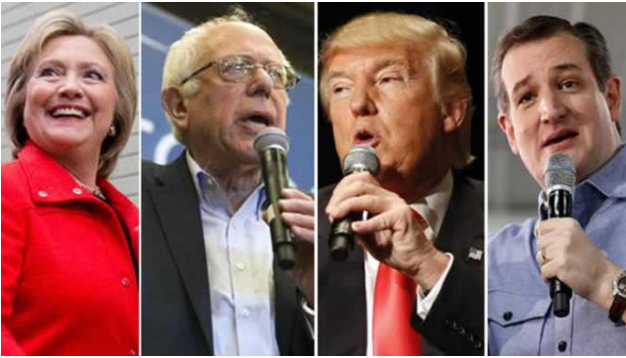
With the New Hampshire primaries once again at our throats, I thought it might be a good public service for me to break down the top four candidates for my readers who - if they're like me - haven't paid any attention to the campaign, save for any Saturday Night Live skits they may have seen on YouTube. I must caution that this is not an exhaustive breakdown of the four leading candidates - so I'm sure there are many more strange and dangerous ideas they are proposing that I’m leaving out. The important thing to remember is this: it really doesn't matter if you vote; and it truly doesn't matter who wins. The important thing is to be entertained by it every four years; like the Olympics without the HGH [although with Hillary Clinton, I’m not so sure].

First, on the Republican/Fascist side:

TED CRUZ - This guy is apparently a senator from Texas, although I've no idea when that happened. The last time I paid attention, Texas' two senators were Phil Gramm and Lloyd Bentsen. I think they may both be dead now. Sorry, got off on a tangent there. When I first heard 'Ted Cruz' I thought it was the former Phillies' infield prospect who went on to win a World Series with the Orioles in 1983.  Turns out that was Todd Cruz. He’s not running.

As far as I can tell, Cruz would be on the right end of the political spectrum, a few paces to the right of Hitler and Ted Nugent. I think he's younger than me, which should automatically disqualify him. But I just reread the Constitution [you might want to try it for the first time, Ted] and it says you only have to be 35-years old.  There's apparently some question about Ted's citizenship, but I'm pretty sure that's not the biggest reason why he shouldn't be president.

Cruz's big issue is apparently repeal of the Thirteenth Amendment. Now, he may have his numbers confused, or he may really want to repeal the amendment that abolished slavery.  My guess is that's not the one he wants to repeal [although it may be the Fourteenth, which would be almost as disturbing]. He wants to repeal Obamacare, with the idea being that healthcare should only be available to those worth keeping alive.

DONALD TRUMP - This one really caught me by surprise. The last time I saw Trump he was running a beauty pageant and banging girls younger than his daughter. Trump's platform is pretty interesting - in the same way that a massive, bloody car wreck is interesting but not necessarily pleasant and is prone to make one vomit.

Among Trump’s more controversial plans: he wants a Constitutional amendment requiring women between the ages of 18-35 to wear thongs and pasties at all times; he’s calling for the construction of a wall around all Taco Bell restaurants; and he wants to ban interracial screwing in the porn industry, calling it “Fucking disgusting – literally.”

Trump is anti-abortion now, with the single exception of saving the figure of the mother – that is, he’s calling for mandatory abortions for any women between the ages of 18-35 with decent figures.


On the Democrat/Socialist side:

HILLARY CLINTON – Jesus Christ, is she still around?! Do you realize this woman has lasted longer than the Beatles and almost as long as the Rolling Stones? I thought she was still in Obama’s Cabinet or chasing her husband around the world as he promoted yet another memoir [his latest is a real hoot, called You Can’t Call it Cheatin’ ‘Cause She Reminds Me of You].

Now, it wouldn’t be Hillary if there wasn’t a group of people calling for her lynching. They seem to be really pissed about her emails while she was in the State Department.  They should’ve seen her husband’s emails in the White House. Now, that’d be a good read. If I’m understanding the story correctly, she had a private server storing her emails while Secretary of State and – although none of them were marked classified at the time – all of them have since been reclassified as ‘Top Secret’, making her a felon facing nearly 294 years in prison. I think she’d serve that term just to piss off the Right.

Hillary’s big issue is that we robbed her of her rightful position as President eight years ago and we damned well better vote for her now. She promises to support most of President Obama’s policies as well as things that’ll make the Right wish that Obama could have run for a third term.

BERNIE SANDERS – I’m pretty sure this is a goof, as the Bernie Sanders I know is a 74-year old Socialist. He has some interesting ideas, including abolishing heterosexual marriage, income tax, and the Department of Defense.

No one appears more surprised [with the exception of Hillary] at Sanders’ candidacy than Bernie himself. Of course, the problem is that Sanders has no interest in being President and has no idea how to stop his own momentum. “I’m going to French-kiss a Boy Scout in Nashua,” Sanders joked when asked how he might derail his candidacy in New Hampshire. Unfortunately, for Sanders and the rest of us, that’s liable to put him over the top.

Sanders’ most controversial stance, though, isn’t even his plan to turn the United States into Norway. No, that title belongs to Sanders' call for a law that will change the name of any landmark named for’ Ronald Reagan’ to ‘That Heartless Bastard’ [i.e. “Welcome to That Heartless Bastard International Airport”].  Sanders’ law would include the renaming of Reagan’s own Presidential Library. Feel the Bern, indeed..